

New Earth Histories brings the history of geosciences and the history of select world cosmologies together. We aim to produce a fresh and cosmopolitan history of environmental sciences, analysing the significance of geological time and multiple cosmologies for global modernity itself.
New Earth Histories: Geo-Cosmologies and the Making of the Modern World
A kaleidoscopic rethinking of how we come to know the earth.
This book brings the history of the geosciences and world cosmologies together, exploring many traditions, including Chinese, Pacific, Islamic, South and Southeast Asian conceptions of earth’s origin and makeup. Together the chapters ask: How have different ideas about the sacred, animate, and earthly changed modern environmental sciences? How have different world traditions understood human and geological origins? How does the inclusion of multiple cosmologies change the meaning of the Anthropocene and the global climate crisis? By carefully examining these questions, New Earth Histories sets an ambitious agenda for how we think about the earth.
The chapters consider debates about the age and structure of the earth, how humans and earth systems interact, and how empire has been conceived in multiple traditions. The methods the authors deploy are diverse—from cultural history and visual and material studies to ethnography, geography, and Indigenous studies—and the effect is to highlight how earth knowledge emerged from historically specific situations. New Earth Histories provides both a framework for studying science at a global scale and fascinating examples to educate as well as inspire future work. Essential reading for students and scholars of earth science history, environmental humanities, history of science and religion, and science and empire.
Order now from the University of Chicago Press.

-
Co-Director
Professor Alison Bashford, FBA, FAHA, FRHistS
E: a.bashford@unsw.edu.auAlison Bashford is Co-Director of the New Earth Histories research program and Director of the Laureate Centre for History and Population at UNSW. Her research connects the history of science, global history and environmental history into new assessments of the modern world, from the 18th to the 20th centuries. Prior to her appointment at UNSW, she was Vere Harmsworth Professor of Imperial and Naval History at the University of Cambridge.
Co-Director
Dr Jarrod Hore
Jarrod Hore is Co-Director of the New Earth Histories Research Program and Scientia Lecturer in the School of Humanities & Languages at UNSW. Working across the fields of environmental history and the history of science, his work on earthquake geology, wilderness photography, early environmentalism, and the logistics of the natural history trade has been published in the Pacific Historical Review, Australian Historical Studies and the Journal of World History. His first book, Visions of Nature: How Landscape Photography Shaped Settler Colonialism was published by University of California Press in 2022. He is currently working on a new history of modern earth science called Deep Earth: How Colonial Geologists Rewrite Our Planet’s Story, which will be published by Polity books in 2027.
Member
Dr Katarzyna Jeżowska
Dr Katarzyna Jeżowska is a cultural historian with a particular interest in design from Eastern Europe. Her PhD (Oxford, 2019) examined the role of design, craft and architecture in imagining ‘modern Poland’ in the three post-war decades. Currently she is completing the manuscript of her first book, which examines the ways in which the socialist state utilised modern design and architecture in international diplomacy during the Cold War period. Her new project, Coal Nations and Carbon Cultures, considers the political potential of industrial exhibitions, placing coal at the forefront of historical enquiry. By examining the complex relationship between natural resources, industrial products and national identity, the project seeks to explain both Poland’s and Australia’s longstanding reliance on this increasingly problematic material resource.
Co-Investigator, ‘Antipodean Geology’ and Distinguished Visitor
Professor Pratik Chakrabarti, FRHistS
University of ManchesterA long-time collaborator and frequent visitor to New Earth Histories, Pratik Chakrabarti is the National Endowment for the Humanities Cullen Chair in History & Medicine at the University of Houston. Pratik has contributed widely to the history of science, medicine, and global and imperial history, spanning South Asian, Caribbean and Atlantic history from the eighteenth to the twentieth century. He has published four sole-authored monographs and several research articles in leading international journals on the history of science and medicine. Pratik is co-editor of the forthcoming New Earth Histories book, Gondwanaland: Modern Histories of an Ancient Supercontinent (University of Pittsburgh Press/UNSW Press, 2026).
Co-Investigator, ‘Antipodean Geology’
Dr Alessandro Antonello
Flinders UniversityAlessandro Antonello is Associate Professor of environmental history and UNESCO Chair in Communication, Environment and Heritage at the University of Tasmania. His work the histories of Australia’s marine and coastal environments, Antarctic environmental knowledge and geopolitics, the cryosphere, and the world ocean in the twentieth and twenty-first centuries. He is the author of The Greening of Antarctica: Assembling an International Environment (Oxford, 2019).
Co-Investigator, ‘Antipodean Geology’
Professor Saul Dubow
University of CambridgeSaul Dubow is the Smuts Professor of Commonwealth History and a Fellow of Magdalene College at the University of Cambridge. His research covers the history of segregation and apartheid; Commonwealth, imperial and post-colonial history; the history of science; and the political dimensions of global intellectual thought. His most recent work, ‘The Scientific Imagination in South Africa 1700 to the Present,’ co-written with William Beinart, was published by Cambridge University Press in 2021. Professor Dubow is a Fellow of the Royal Historical Society and the Stellenbosch Institute of Advanced Studies.
Member
John Gascoigne
John Gascoigne was educated at Sydney (BA hons 1), Princeton (MA) and Cambridge Universities (PhD and Litt.D) and is a fellow of the Australian Academy of the Humanities. He has taught in Papua New Guinea and has been at UNSW since 1980. His publications have dealt with the impact of the Scientific Revolution and the Enlightenment along with eighteenth-century exploration. His most recent monographs are Captain Cook. Voyager between Words (Continuum, 2007), winner of the Frank Broeze biennial prize of the Australian Maritime History Association, Encountering the Pacific in the Age of the Enlightenment (Cambridge University Press, 2014), and Science and the State (Cambridge University Press, 2019).
Member
Grace Karskens
Grace Karskens is Emeritus Professor of History in the School of Humanities and Languages at the University of New South Wales. Her research areas include Australian colonial and cross-cultural history, Aboriginal history and environmental history. Her books include Inside the Rocks: The Archaeology of a Neighbourhood, the multi-award winning The Rocks: Life in Early Sydney and The Colony: A History of Early Sydney, which won the 2010 Prime Minister’s Literary Award for non-fiction. Grace's latest book People of the River: Lost Worlds of Early Australia was published by Allen & Unwin in 2020.
Honorary Fellow
Dr Emily Kern
E: e.kern@unsw.edu.au
T: @kern_emEmily Kern is an assistant professor at the University of Chicago, where she researches and teaches the intellectual and cultural history of modern science. She is currently at work on a book about the long history of the African origins hypothesis and the search for the cradle of humankind, under contract with Princeton University Press. Her research focuses on the relationship between the production of scientific knowledge about the human species and the production of global political power in the nineteenth and twentieth centuries. She is a graduate of the University of Pennsylvania (BA 2012) and Princeton University (PhD 2018). At Princeton, she was awarded a Charlotte Elizabeth Procter Honorific Fellowship (2017-2018) and held a Graduate Prize Fellowship from the University Center for Human Values (2016-2017).
Honorary Fellow
Dr Adam Bobbette
E: a.bobbette@unsw.edu.auAdam Bobbette is a geographer and Lecturer in the School of Geographical and Earth Sciences, University of Glasgow. His research relates to the intersections of people with vulnerable and volatile environments. Following a PhD from Cambridge, he is working on a book, “At Earth’s Edge: The Political Geology of Indonesia”, that focuses on the intersection of politics and geology through the lens of Indonesia’s volcanoes.
Visiting Professorial Fellow
Emeritus Professor David Christian
David Christian is an internationally recognised historian of Russia, the Soviet Union and Inner Asia who, since 1989, has been instrumental in the development of Big History. Over the last 30 years, Prof. Christian has written history at all scales and across many disciplines, publishing eight sole-authored monographs and delivering many influential seminars, lectures and talks. He is a Fellow of the Australian Academy of the Humanities, the Royal Holland Society of Sciences and Humanities, and the Royal Society of New South Wales.
Distinguished Visitor
Professor Nigel Clark
University of LancasterNigel Clark is Professor of Human Geography at the Lancaster Environment Centre, University of Lancaster. Nigel’s scholarship engages themes at the heart of the environmental humanities, such as the relationship between humans and nature, the social studies of science and technology, more-than-human ethnography and extinction studies. He has contributed widely to debates around the human consequences of the emerging geological epoch of the Anthropocene.
Distinguished Visitor
Professor Naomi Oreskes
Harvard UniversityNaomi Oreskes is Professor of the History of History and Affiliated Professor of Earth and Planetary Sciences at Harvard University. A world-renowned geologist, historian and public speaker, she is a leading voice on the role of science in society and the reality of anthropogenic climate change.
Co-Investigator, ‘Antipodean Geology’
Associate Professor Gregory Cushman
University of Kansas -
News
- The University of Pittsburgh Press will publish Gondwanaland: Modern Histories of an Ancient Supercontinent in late 2027. Edited by Alison Bashford, Pratik Chakrabarti, and Jarrod Hore this book features chapters from many long-time New Earth Histories visitors and collaborators, including Professor Saul Dubow, Professor Sumathi Ramaswamy, Professor Nigel Clark, and Dr Andrea Westermann.
- Jarrod Hore has signed a contract with the UK publisher Polity for his next book, Deep Earth: How Colonial Geologists Rewrote our Planet’s Story. This trade book for a general audience, tells the story of how three generations of colonial geologists became expert mediums of a changing planet by searching the globe for minerals and resources. It explains how their endeavours became essential to the development of epic new ideas about the Earth’s deep past and now frame our expectations of the future. Deep Earth will be published in 2027.
- The Gondwana/Land project was recently featured on the UNSW Newsroom. You can read this article, which features both Alison Bashford and Jarrod Hore, on the UNSW Newsroom on the Australian Geographic website, where it was syndicated.
- Alison Bashford visted University College London in June 2024 to deliver the Annual Lecture for the Centre for Transnational and Global History, ‘Gondwanaland – The Transnational History of Southern Earth.’
- Alison Bashford’s book The Huxleys: An Intimate History of Evolution (Allen Lane/University of Chicago Press) has been shortlisted for the Hughes Prize, British Society for the History of Science and longlisted for the 2023 Cundill History Prize and the 2023 Mark and Evette Moran Nib Literary Award.
- Jarrod Hore's book Visions of Nature: How Landscape Photography Shaped Settler Colonialism has been shortlisted for the General History Prize in the New South Wales Premier's History Awards. This comes after Visions of Nature was awarded the inaugural Marilyn Lake Prize for Australian Transnational History, at the Australian Historical Association Annual Meeting in July, and the Donna Coates Prize for the best first book to investigate Australia, Canada, and/or Aotearoa New Zealand by the Australian, Canadian, and New Zealand Studies Network earlier in 2023.
- Jarrod Hore reviewed Peter Frankopan's latest book, 'The Earth Transformed: An Untold Story' for The Sydney Morning Herald and The Age. You can read the review, which addresses Frankopan's use of scientific evidence and his analysis of connection and vulnerability in earth history, here.
- Alison Bashford’s latest book An Intimate History of Evolution: The Story of the Huxley Family has been published by Penguin and the University of Chicago Press. The book tells the story of two hundred years of modern science and culture through one family history. It has already been reviewed in the London Review of Books and Inside Story
- Jarrod Hore’s first book, Visions of Nature: How Landscape Photography Shaped Settler Colonialism was published by the University of California Press. This book revives the work of late nineteenth-century landscape photographers who shaped the environmental attitudes of settlers in the colonies of the Tasman World and in California. You can hear Jarrod in conversation with ABC’s Phillip Adams here and with the University of Sydney’s Dallas Rogers here.
- Alison Bashford has been awarded a prestigious Dan David Prize for her wide-ranging work on public health, medicine, disease control, borders and quarantine. She is one of seven Laureates for 2021. She joins pre-eminent academics Professor Katharine Park and Professor Keith Wailoo in the History of Health and Medicine (Past) category. Other Laureates include Dr Anthony Fauci in the Present category and Professor Zelig Eshhar, Professor Carl June and Dr Steven Rosenberg in the Future category.
- Alison Bashford and Alessandro Antonello, Flinders University, have been awarded an Australian Research Council Discovery Grant for their project, 'Antipodean Geology: A Modern History of Southern Hemisphere Earth', which will examine the modern history of the ancient supercontinent Gondwanaland. Alison and Alessandro will lead an international team of historians including Pratik Chakrabarti, University of Manchester, Saul Dubow, University of Cambridge, Greg Cushman, University of Kansas, and Jarrod Hore, UNSW, to reorient the history of geosciences towards the southern hemisphere by investigating geologists working in Australasia, South Asia, South America, Southern Africa and Antarctica since 1788. The team aims to recast ideas of a global south and improve understandings of what ‘Gondwana’ and deep geological time mean for societies across the southern hemisphere.
- Alison Bashford and Jane McAdam, Law & Justice, UNSW, have been awarded an Australian Research Council Special Research Initiative grant for a project focusing on laws and regulations that have restricted people’s movement within Australia during epidemics and pandemics over the past 120 years. They recently spoke with UNSW Newsroom about the project, ‘Rethinking Medico-legal Borders: From International to Internal Histories’, which will analyse four instances where the movement of people in Australia has been up for debate: the plague (1899–1903), 1918–19 influenza, SARS (2002–03) and COVID-19.
- Alison Bashford has featured alongside other leading historians of public health, epidemics and disaster science in the Los Angeles Review of Books. They were asked to reflect on how history is being used in the coverage of COVID-19, how it has impacted their scholarship and what tools we have for understanding pandemics.
- Jarrod Hore's essay 'Reckoning with Urgency: Crisis & Radical Environmental History' was published by the Australian and New Zealand Environmental History Network in their new 'Insights' series. Jarrod's essay responds to a new Forum in 'History Australia' dedicated to 'Doing History in Urgent Times.
- Alison Bashford and Pratik Chakrabarti, University of Manchester, have been awarded an international network seed grant from the Arts and Humanities Research Council (UK), Gondwanaland and Antipodal Histories.
- Adam Bobbette, Latu Latai (Malua Bible School) and Sarina Theys (Newcastle) have been awarded a British Academy seed funding grant for "Churches, Science and Climate Change,” integrating climate science and theology in the Pacific.
- Emily Kern has been awarded a 2019 Division of History of Science and Technology dissertation prize from the International Union of the History and Philosophy of Science and Technology for her dissertation “Out of Asia: a global history of the scientific search for the origins of humankind, 1800-1965,” (Princeton University, April 2018).
- Jarrod Hore has been awarded the David Scott Mitchell Memorial Fellowship at the State Library of New South Wales for his project 'Grounding Colonial Science'. During 2020 Jarrod will explore the vast archive of a leading colonial geologist, reflect on how he saw and wrote about the Australian landscape, and the impact those responses generated in his thinking about science.
- Shaping the New World: World-leading historian Alison Bashford has always been interested in how the past shapes our present. Read more on shaping the new world.
Selected Past Events
Historians on Planetary Futures – Seminar Series

Is Deep History White? - A lecture and roundtable
Distinguished Visiting Professor Pratik Chakrabarti questions the epistemological premises of deep history and mounts an argument that it is complicit in the Western and colonial appropriation of global nature, time, myths and capital. This online lecture took place on 14 July. It was followed on 15 July by a roundtable featuring Prof. Chakrabarti, historians Prof. Lynette Russell (Monash), Prof. Ann McGrath (ANU), Dr Shino Konishi (UWA), Dr Ben Silverstein (ANU) and Dr Emily Kern (UNSW). Chaired by Prof. Alison Bashford, the panel discussed the whiteness of deep history, the characteristics of European naturalism, and the enchantment and disenchantment of the natural world.
Decolonising Geology
Decolonising geology was a discussion held on July 3, 2020, hosted by the New Earth Histories Research Program at the University of New South Wales. It was moderated by Adam Bobbette and included Ruth Gamble (La Trobe University), Cin-Ty Lee (Rice University), and Christopher Wilson (Flinders University). The discussion was about how researchers from different fields—history, earth sciences, and archaeology—understand the relationship between geology and society, time, cosmology, Indigenous knowledges, and what it means to decolonise geology.
-
Alison Bashford, ‘Is Deep History White? An Afterword,’ Isis 116, no. 4 (December 2025)
Alison Bashford, ‘The New Modern Synthesis: E.O. Wilson and Julian Huxley,’ Historical Studies in the Natural Sciences 55, no.1 (2025).
Jarrod Hore, ‘History of the Earth Sciences from the South,’ Handbook for the Historiography of the Earth and Environmental Sciences, edited by Elena Aronova, David Sepkoski and Marco Tamborini (Springer, 2023).
Jarrod Hore, ‘Beyond the Lens: Settler Colonialism, Photography, and Environmental History,’ Global Nineteenth-Century Studies 4, 1 (May 2025).
Jarrod Hore, ‘Stereograph Futures in Southern California,’ in The Museum is Not Enough no. 10-14 (Montreal: Canadian Centre for Architecture & Sternberg Press, 2024).
Alison Bashford, Emily Kern, and Adam Bobbette, New Earth Histories: Geo-Cosmologies and the Making of the Modern World (Chicago: University of Chicago Press, 2023).
Jarrod Hore, ‘The Voices of an Eloquent Earth: Tracing the Many Directions of Colonial Geo-Theology,’ New Earth Histories: Geo-Cosmologies and the Making of the Modern World, edited by Alison Bashford, Emily Kern and Adam Bobbette (University of Chicago Press, 2023).
Alison Bashford, An Intimate History of Evolution: The Story of the Huxley Family (London: Penguin, 2022).
Jarrod Hore, Visions of Nature: How Landscape Photography Shaped Settler Colonialism (Oakland: University of California Press, 2022).
Jarrod Hore, ‘Chains of Custody, Oceans of Instability: The Precarious Logistics of the Natural History Trade,’ with Vanessa Finney and Simon Ville, Journal of World History (2022).
Jarrod Hore, ‘Settlers in Earthquake Country: Apprehending Instability in New Zealand and California,’ Pacific Historical Review (February 2022).
Alison Bashford, Pratik Chakrabarti and Jarrod Hore, ‘Towards a Modern History of Gondwanaland,’ Journal of the British Academy (2021).
Jarrod Hore, ‘Reckoning with Urgency: Crisis & Radical Environmental History,’ Australian and New Zealand Environmental History Network, Insights Series (June 2020): https://www.environmentalhistory-au-nz.org/insights/articles-essays/reckoning-with-urgency-crisis-radical-environmental-history/
Jarrod Hore, Review of Pete Minard, All Things Harmless, Useful & Ornamental: Environmental Transformation Through Species Acclimatization from Colonial Australia to the World (University of North Carolina Press, 2019), in History Australia 17, 3 (2020), 578-580.
Alison Bashford, ‘The Family of Man: Cosmopolitanism and the Huxleys, 1850-1950’, Humanity: An International Journal of Human Rights, Humanitarianism and Development, 12, no. 1 (Spring 2021). Special issue ‘Cosmopolitanism’ ed. Valeska Huber.
Alison Bashford, 'Beyond Quarantine Critique', Somatosphere, March 6 2020.
Emily Kern,'Archaeology enters the ‘atomic age’: a short history of radiocarbon, 1946–1960', British Journal for the History of Science, 53, no. 2 (2020), 202-227.
Alison Bashford, ‘On nations and states: a reflection on ‘Thinking the Empire Whole’, History Australia, 16, no. 4 (2019), 638-641.
Alison Bashford, Chris Otter, John L. Brooke, Frederik A. Jonsson, and Jason Kelly, 'Roundtable: The Anthropocene in British History,' Journal of British Studies, 57, no. 3 (2018), 568-596.
Adam Bobbette, 'Singing Disappearance: Javanese Songbird Competitions and the Ventriloquizing of Extinction,' Cabinet, 66, (Spring 2018-Winter 2019).
Alison Bashford, ‘Deep Genetics: Universal History and the Species’, History and Theory, 57, no. 2 (2018), 313-22.
Adam Bobbette and Amy Donovan, eds. 'Political Geology: Active Stratigraphies and the Making of Life,' Palgrave/Macmillan, 2018.
Alison Bashford (ed.), 'Oceanic Histories,' (Cambridge: Cambridge University Press, 2017). Co-editor with David Armitage and Sujit Sivasundaram.
Alison Bashford, ‘Terraqueous Histories,’ The Historical Journal, 60, no. 1 (2017), 1–20.
-
-
New Earth Histories Research Program
Morven Brown Building, Rms 243-247
University of New South Wales
-
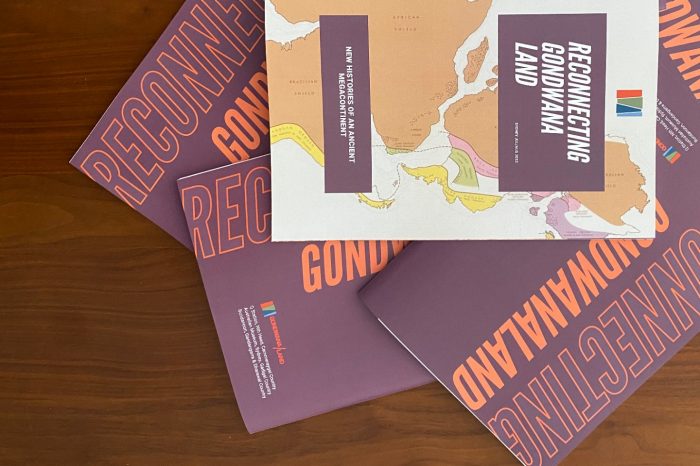
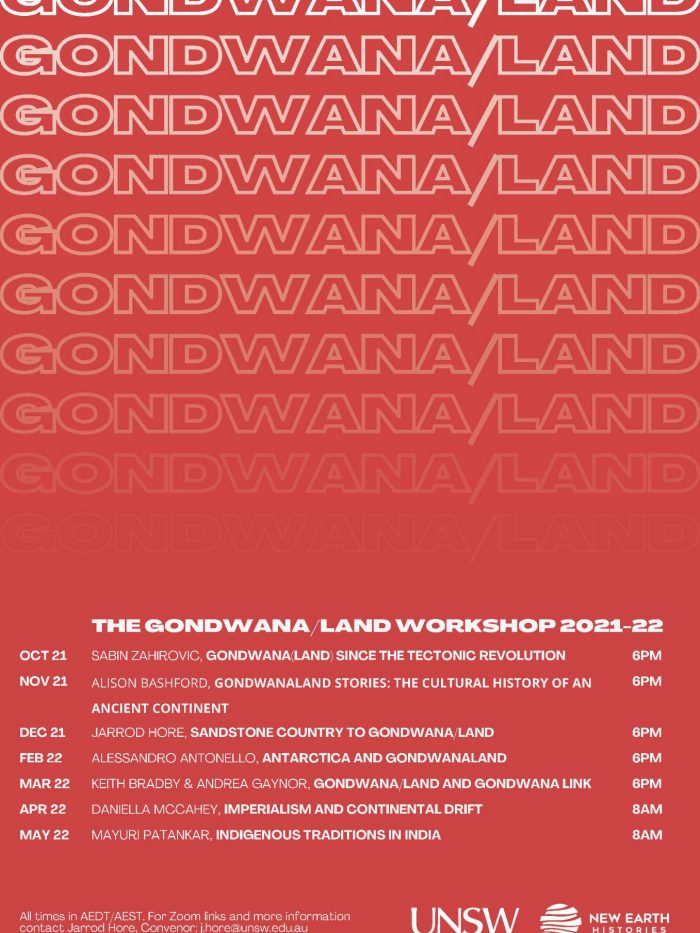
Earth scientists know a great deal about the geological history of Gondwanaland and its breakup that began 180 million years ago, eventually creating present day Africa, Australia, New Zealand, South America, South Asia and Antarctica. This project addresses the possibilities that emerge when we consider Gondwanaland’s national and continental fragments according to a series of modern environmental, cultural, political, colonial, and postcolonial histories. Aware of its now-proliferating trans-local meanings, we situate Gondwanaland, first, in the central Indian homeland of the adivasi Gond people, who lent the supercontinent its name in the late nineteenth century. From here the developing geopolitics of Gondwanaland are harder to anticipate. Gondwanaland’s modern history is strange and little understood, our idiosyncratic ‘transnational’ project seeking to open up its recent past, and in a way bring Gondwanaland back together again.
Scoping its significance across both human and earth histories, the Gondwana/Land project brings together historians of Antarctica, Australia, southern Africa, South Asia and South America.
This project launched in July 2021, and includes lead researchers Alison Bashford (CI, UNSW), Alessandro Antonello (CI, Flinders), Jarrod Hore (UNSW), Pratik Chakrabarti (Manchester), Gregory Cushman (Kansas), Saul Dubow (Cambridge).


