Academic Success Monitor
A new tool in Moodle designed to help you stay on track with your studies at UNSW

A new tool in Moodle designed to help you stay on track with your studies at UNSW
The Academic Success Monitor (ASM) uses existing data like your course engagement, assessment marks, study load and patterns from past students to spot when you might need help.
If the ASM identifies that you require support, you'll receive an alert so you can act early or reach out for assistance. It also recommends which support services you might need, whether it's academic advice, wellbeing resources or study support.
The ASM can make mistakes. It uses probabilities based on data and patterns, so errors can happen. Learn more.
Your privacy matters. We keep your data secure and follow UNSW Privacy Policies. The data in the ASM can only be used to support you and improve your learning experience. Learn more or email privacy@unsw.edu.au if you have questions.
The ASM is here to help, but we know that speaking to someone may sometimes be what you really need. If you feel overwhelmed or are struggling, you're not alone. Reach out for a confidential conversation.
We want to hear from you! Let us know your thoughts on the Academic Success Monitor and help us improve.
Important: Any information in the ASM only forms part of your picture and only shows parts of your academic participation at UNSW. For the best guidance, always speak with your course convenors, academic advisors and other UNSW support staff.
The ASM will suggest the level of support you might need through a simple colour-coding system:

Green: Everything seems to be on track - checking in with the ASM reassures you that you're on the right path and to keep building good study habits.

Orange: If you're facing some challenges, the ASM will help find areas for small adjustments or extra support to make a difference. For example, time management tips, study strategies or seeking academic guidance.

Red: If things feel challenging, the ASM will point you toward resources that can help you get back on track.
The ASM will also measure its confidence in its prediction, based on past data. This number tells you how reliable the success prediction is.

The ASM uses success factors and risk factors to build its predictions based on observations of your previous grades, study load, course information, assessment marks, Moodle activities and more.

The top section of the ASM block on Moodle includes a hyperlink to the ASM website for more information. We also provide regular notifications to help you explore the functionalities of the ASM or share feedback with our team.
The yellow section reveals the level of support the ASM thinks you might need. Click on 'find out more' to read through more information and some support suggestions you might find useful.
The top 5 most accessed activities by your peers will show you which class resources are getting a lot of attention.
At the bottom of the ASM block, you have the opportunity to provide feedback.

Key features include:

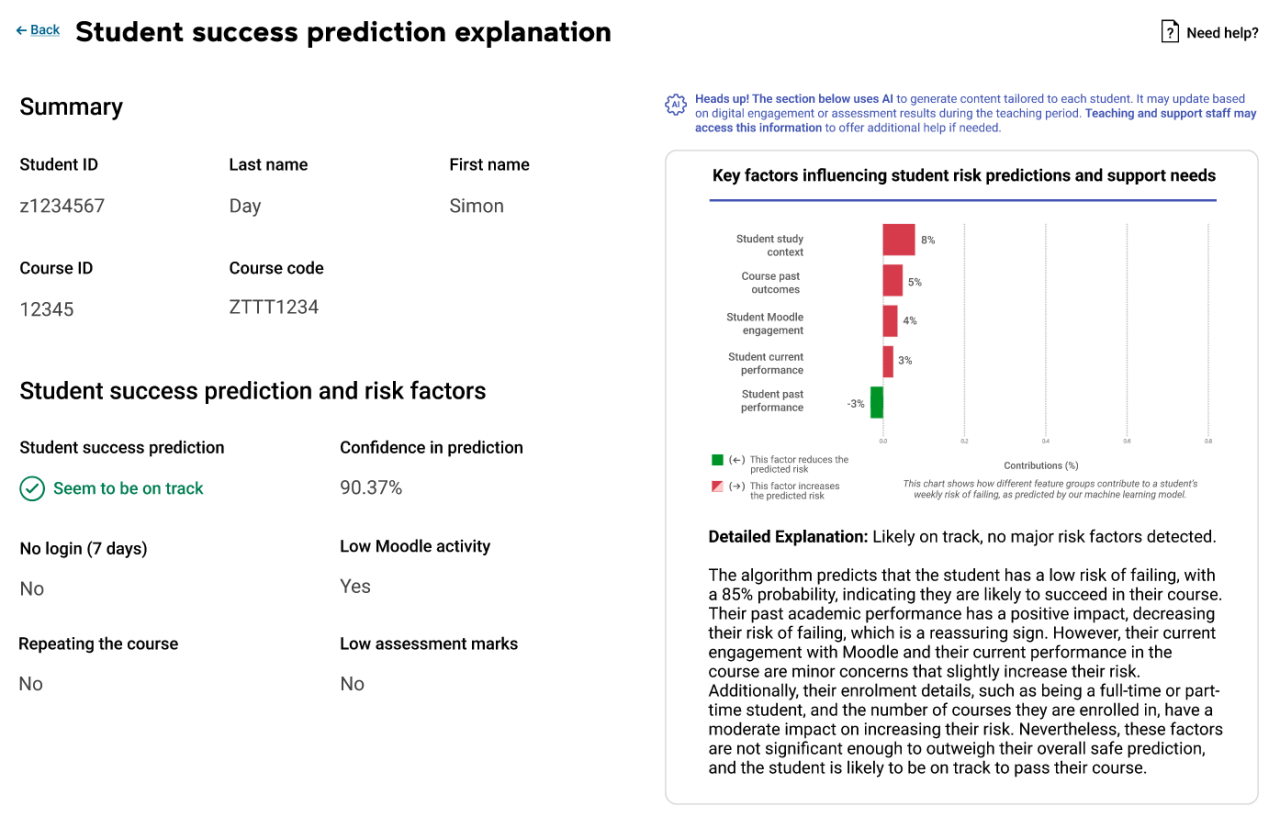
When you click on 'See more detailed explanation' under your ASM prediction, you will be taken to the prediction explanation page.
On the left you'll see:
On the right, you'll see a breakdown of your prediction, with a graph explaining why the ASM has predicted either green, orange or red. It will show some factors that influenced the prediction and how much each one contributed, including:
UNSW is introducing the Academic Success Monitor to enhance student success and streamline academic support through the use of learning analytics.
ASM uses AI and machine learning to identify students who may be at risk academically, based on engagement data from Moodle.
You’ll receive personalised messages with tips and links to support services designed to help you take action early and stay on track.
In pilot testing, ASM correctly identified 81% of students who later failed and AI nudges increased student engagement by 20%.
It’s built into Moodle, so it’s easy to access and designed to support your success throughout the term.
ASM helps UNSW provide timely, tailored support while reducing the admin load for teaching staff.
In the Academic Success Monitor, you’ll find helpful insights and tools designed to support your academic progress. Here's what you can expect:
Support predictions: The ASM uses machine learning to estimate how you're tracking in your course, whether you might need support and the level of support you might need.
Support suggestions: Based on your activity, the ASM recommends relevant UNSW support services, such as academic skills workshops or wellness resources.
Contributing factors: You’ll see a breakdown of factors influencing your support prediction, giving you clarity on what might be affecting your performance.
Alerts for action: If there's a high chance of academic difficulty, the ASM will notify you so you can take action early.
The Academic Success Monitor at UNSW calculates predictions using a machine learning model trained on historical student data. Here's how it works:
Data sources: The ASM pulls data from Moodle, SiMS and other UNSW systems, including your engagement with course materials, participation patterns and demographic information.
Engagement analysis: It compares your digital activity (like logins, quiz attempts and forum posts) with patterns from previous students to assess your academic trajectory.
Risk prediction: The model identifies signs of academic risk early in the term, often within the first few weeks, so you and your course convenor can take action before issues escalate.
Accuracy: In pilot studies, the ASM correctly predicted 81% of student failures early, with weekly prediction accuracy around 61%.
The data in the Academic Success Monitor can only be used to support you and improve your learning and university experience. It is based on existing information from Moodle and myUNSW - nothing new is being collected.
The ASM uses a combination of data sources to calculate predictions and provide insights. Here’s what it typically includes:
Moodle activity and assessment data: Logins, clicks, assessment and quiz marks (both compulsory and optional quizzes).
Enrolment data: Study load, previous grades and WAM.
Historical performance patterns: Data from previous cohorts (how much previous students engaged, their grades and if the course has a failure rate etc.)
To keep things fair and unbiased, the ASM does not use demographical or personal details.
If you have questions or concerns about the use of your personal information, contact the University’s Privacy Officer at privacy@unsw.edu.au.
Yes, ASM can make mistakes because it relies on predictions based on data patterns, not absolute certainty. Here’s why the data might look off:
Data gaps: If your Moodle activity or assessment submissions aren’t fully captured, the prediction may be inaccurate.
Model limitations: ASM uses historical patterns and engagement trends, so unusual study habits or technical issues can skew results.
Early predictions: The system makes forecasts early in the term, which can change as you engage more.
If something looks wrong, let us know. Contact The Nucleus: Student Hub if you are a UNSW Sydney student and Student Administrative Services if you are a UNSW Canberra student.
Feeling overwhelmed? We’re here to help. Contact UNSW Psychology & Wellness for a confidential conversation, or book time with a UNSW Student Support Advisor for other personal or academic advice.
The messages you see in ASM are automated notifications generated by UNSW’s Academic Success Monitor system, not from an individual person. They are:
AI-driven support nudges based on your engagement and progress data.
Intended to send personalised tips and reminders to help you stay on track.
Designed by UNSW’s PVC Education Team to guide you toward helpful resources.
Sent to your zID as a formal UNSW communication.
If you're unsure about a message or need clarification, you can always contact The Nucleus: Student Hub if you are a UNSW Sydney student and Student Administrative Services if you are a UNSW Canberra student.
Feeling overwhelmed? We’re here to help. Contact UNSW Psychology & Wellness for a confidential conversation, or book time with a UNSW Student Support Advisor for other personal or academic advice.
Yes, only the following staff can see your data:
This helps them understand your learning needs and provide timely support. All data is managed under UNSW's privacy and security policies and is only used for academic support.
If you have questions or concerns about the use of your personal information, contact the UNSW Privacy Officer at privacy@unsw.edu.au.
The ASM ensures data security and ethical uses of educational data in a number of ways:
A Privacy Impact Assessment has been completed with UNSW Legal and Compliance. The ASM follows advice from its Steering Committee (made up of UNSW teaching and professional staff, as well as your student peers), UNSW Legal and Compliance and University Planning and Performance to comply with UNSW policies and data governance requirements.
The ASM has implemented the Microsoft Responsible AI framework that increases transparency and helps to identify potential bias in machine learning and artificial intelligence applications.
The ASM assures data security and ethical use by design, i.e. controlled user access, level of access and user training.
If you have questions or concerns about the use of your personal information, contact the University’s Privacy Officer at privacy@unsw.edu.au.
Learning analytics isn’t new – it’s already helping students succeed at many universities in Australia and overseas.
At the University of Sydney, the Student Relationship Engagement System (SRES) has supported students since 2012.
Deakin University introduced Genie, a digital personal assistant for students, in 2018.
Other examples include RiPPLE at the University of Queensland and iLEARN Insights at Macquarie University. The University of Michigan and Imperial College London also use learning analytics to support students.
For more information on how the ASM works, check out our video above or visit our public ASM site for more information.
Feeling overwhelmed? We’re here to help. Contact UNSW Psychology & Wellness for a confidential conversation, or book time with a UNSW Student Support Advisor for other personal or academic advice.
If you have questions or concerns about the use of your personal information, please contact privacy@unsw.edu.au.

